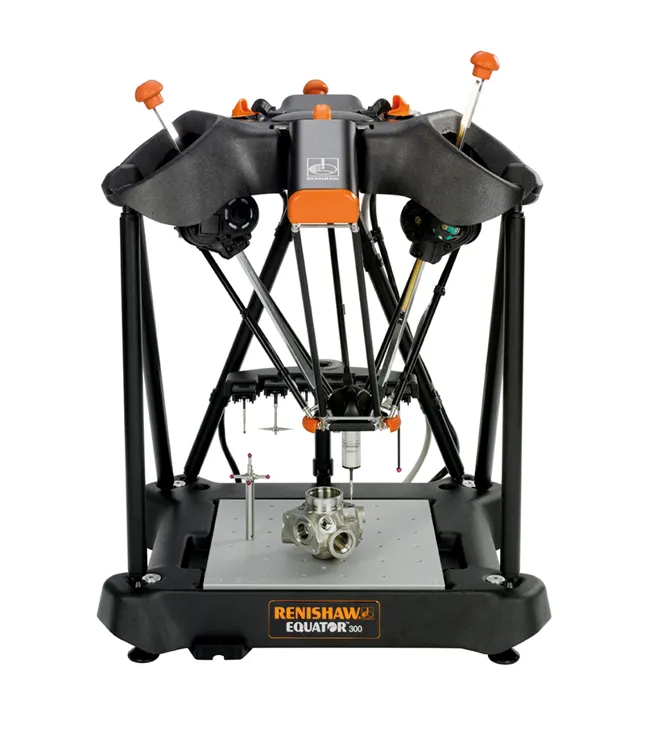
Equator™ Production Gauge

The Equator™ production gauge enables fast and precise measurement of components. Thanks to Equator™’s advanced technology, it delivers reliability and accuracy, which are crucial in manufacturing processes.

Equator System as an Alternative to Traditional Comparative Measurement

The Equator system offers measurement flexibility that is invaluable for both low-volume and high-volume production. Its ability to quickly adapt to changing production conditions makes it an ideal choice for companies seeking efficient quality control methods.

Equator stands out for its ability to perform precise inspection of parts even under variable temperature conditions. Its advanced compensation algorithms ensure accurate measurement results regardless of environmental influence. This makes Equator an indispensable tool in manufacturing environments where temperature stability cannot always be guaranteed.


Contact with us!

equator


Equator as an in-process inspection system – eliminating errors at an early stage

The Equator system enables detection of production deviations before the final quality inspection stage. This makes it possible to quickly identify irregularities and implement corrective actions before defects affect larger production batches. Such an approach significantly reduces the risk of scrap and helps maintain the stability of the manufacturing process.

In-process inspection carried out using the Equator system allows continuous monitoring of part quality during production. This means operators can react immediately to process changes and introduce corrections without stopping the entire production line. In many cases, these activities are complemented by the use of measuring arm technology, which extends inspection capabilities to measurements performed directly on larger components and increases analysis accuracy in more demanding production areas.

Stability of Equator measurements in changing production conditions

Temperature compensation in the Equator system plays an important role in maintaining measurement accuracy on the shop floor, where environmental conditions often fluctuate. Temperature variations can affect measurement results, which is why compensating for these changes ensures more reliable data and reduces the risk of incorrect interpretation.

The implemented compensation mechanisms enable measurement repeatability even in variable environments. As a result, quality control can be performed without transferring parts to stable laboratory conditions, leading to higher operational efficiency and shorter production cycle times, while also ensuring measurements better reflect the actual operating conditions of the machines.

How to implement Equator into an existing process without downtime?

Implementation of the Equator system in a production facility is carried out in stages and begins with an analysis of process requirements and production specifics. The next step involves configuring the device and adapting it to the requirements of a particular application, followed by operator training and practical implementation of measurement procedures.

This carefully planned implementation process minimizes the impact of changes on ongoing production. Integration with the existing production line is smooth and does not require stopping plant operations, which is especially important in continuous production environments or projects with short lead times, where any interruption could generate additional costs and delays.

Quality control bottlenecks – how Equator improves production flow

In many manufacturing facilities, quality control becomes the stage that limits the pace of the entire process. Parts waiting for inspection accumulate, extending order lead times and disrupting production flow, especially in high-volume manufacturing. This issue most commonly occurs when the number of inspection stations cannot keep up with machine throughput.

The use of the Equator system helps distribute the quality control workload and move part of the inspection process directly onto the shop floor. As a result, parts can be verified continuously without creating queues or downtime. Consequently, quality control is no longer a production bottleneck but becomes an integral part of a smooth and efficient manufacturing process.

Fast serial inspection without compromising accuracy – the advantage of the Equator system

The Equator system has been designed for environments where both measurement speed and repeatability are essential. In serial production, it enables efficient inspection of large numbers of parts in a short time without the need for more time-consuming measurement methods typically associated with metrology laboratories.

The comparative measurement strategy allows rapid detection of deviations from a reference master part, significantly improving decision-making processes. Operators can immediately respond to changes and adjust machining parameters before larger batches of defective parts are produced. As a result, manufacturers can maintain high production quality while simultaneously increasing operational efficiency.

FAQ

1. What is the Equator production gauge and what is it used for?

The Equator production gauge is a measurement system designed for fast and precise inspection of components directly in the production environment. It allows verification of parts’ compliance with quality requirements and reduces the risk of errors.

2. Why is the Equator system an alternative to traditional comparative methods?

The Equator system offers greater flexibility than conventional measurement solutions. It performs well in both low- and high-volume production, allowing quick changeovers and adaptation to changing conditions. It streamlines quality control without the need for dedicated gauges for each part.

3. How does Equator perform under variable temperature conditions?

Equator uses advanced compensation algorithms that account for the impact of ambient temperature on measurement results. This ensures accuracy even in unstable production environments.